Categories
Not A Party, not a problem

The Revolution Nobody Organised

 
Thoughts on collapse, human agency and the new code for living
 
By Bob Wessex
 
In his recent Underthrow essay, We Need a Code (15 October 2026), Max Borders describes a civilisation afflicted by resentment, alienation and spectacle. His observations will be familiar to anyone who has watched political disagreement become a substitute for conversation, personal suffering become an identity, and the performance of virtue become more important than the practice of it. Yet his message is ultimately one of encouragement. He believes we can recover our agency, form communities around shared values and begin building a civilisation worth inhabiting, without waiting for the institutions of the old one to save us.
 
I believe we are already doing precisely that, although not necessarily in the form anyone expected. An extraordinary experiment in human agency is underway. Its participants number in the millions, it requires no membership or common ideology, and most of those involved would be astonished to discover that their activities might have revolutionary implications.
 
Human beings have never waited for permission to participate in life. They did not require a government programme to begin using motor vehicles, establish towns, adopt cellphones or discover the possibilities of the internet. New technologies entered ordinary life because people found them useful, pleasurable, convenient or liberating. Society reorganised itself around those discoveries, often long before institutions understood what was happening.
 
The public release of conversational language models in 2022 was an unusual event in the history of technology. A sophisticated computational capability, developed through enormous concentrations of capital and expertise, became available to ordinary people through something as familiar as conversation. There were no entrance examinations, professional licences or requirements to demonstrate an economically respectable purpose. People were simply invited to experiment – and experiment they did!
 
They began writing software without being professional programmers, composing songs without mastering musical notation, producing animated music videos and generating illustrated books and graphic novels on their kitchen tables. They created websites for small businesses, developed commercial ideas, designed products, investigated unfamiliar subjects and established connections with people whose interests complemented their own. Somebody made a birthday card that sang and danced for a delighted child. Somebody else finally wrote (and illustrated) the novel they had been carrying around in their imagination for thirty years.
 
Much of this activity had no grand purpose whatsoever. It was undertaken because it was interesting, entertaining, satisfying or simply fun. Nobody was attempting to save civilisation by making a psychedelic music video. People were enjoying the discovery that they could turn an idea into something tangible without first assembling the resources, qualifications and institutional support that might previously have been required. Work that once demanded specialist teams and months of coordination could, in some circumstances, now be attempted by an individual over a weekend.
 
It is worth remembering that language models are extraordinarily powerful computational systems, but they are not intelligent. They have no lived experience, personal understanding or independent stake in the consequences of their advice. They can produce astonishingly useful results while remaining spectacularly wrong about elementary matters. Their usefulness arises from the interaction between computational power and human intelligence: the experience, imagination, judgment and curiosity of the person using them.
 
There is another remarkable aspect to this development. Although we often communicate with these systems through written language, many can now conduct spoken conversations, listening to questions and responding aloud. Reading and writing are therefore no longer prerequisites for many forms of participation. For the first time in human history someone who struggles with literacy, or focus, or has limited formal education is not excluded. Neither is written communication a prerequisite any longer as the illiterate can use these tools, explore ideas, seek explanations and develop projects through speech alone. The significance of obliterating that barrier, particularly in societies where formal education has long determined access to opportunity, should not be underestimated.
 
Now, in the course of enjoying these new capabilities, people may have stumbled upon a discovery far more consequential than the technology’s original applications suggested.
 
The Accidental Discovery
History is full of discoveries made while people were looking for something else. Penicillin and X-rays are familiar examples of developments whose significance emerged through unexpected observations. A technology introduced for one purpose can reveal possibilities that alter our understanding of an entirely different problem.
 
Language models were not released to the public as a programme for psychological (or any other) emancipation. Yet people began using them to talk, sometimes for hours, weeks and even months, about the experiences, anxieties, ambitions and unresolved difficulties of their lives. In the process, some discovered that the opportunity to examine their thoughts through an endlessly available conversational interface could be remarkably useful.
 
I have a deeply personal interest in this development. My daughter died by suicide while taking psychiatric medication, and I have spent years thinking about the limitations of the systems through which we attempt to understand and alleviate human suffering. I know how easily a person’s life can become organised around appointments, diagnoses, treatments and the management of symptoms, while the broader question of what that person might still accomplish despite their emotional difficulties, receives comparatively little attention.
 
A language model is not a therapist, nor is it an impartial or infallible third party. It can misunderstand, flatter, mislead and reinforce mistaken beliefs. Nevertheless, it offers something unusual: a conversational space in which thoughts can be examined, arguments tested, experiences articulated and practical possibilities explored without the scheduling, cost or social pressures or stigma that often accompany human consultation.
 
The evidence that such interactions can be beneficial is beginning to emerge. A systematic review and meta-analysis published in npj Digital Medicine in March 2026 examined randomised controlled trials involving more than 7,000 participants and found statistically significant, (generally modest) reductions in depressive and anxiety symptoms among people using mental-health chatbots. A separate review published in the Journal of Medical Internet Research in December 2025, concentrating on generative conversational systems, analysed 14 randomised trials involving 6,314 participants and likewise reported an average improvement in mental-health outcomes. Particularly interesting was its finding that socially oriented conversational systems tended to perform better than those designed primarily to complete specific tasks.
 
These studies do not establish that ordinary, unrestricted conversations produce the same benefits, nor that language models can replace professional care. They do, however, provide empirical support for taking seriously something many users have begun to describe from personal experience. I am particularly interested in what happens beyond the alleviation of symptoms.
 
Consider the person who begins by discussing their unhappiness and ends by writing a song. The individual who has been unemployed for years and discovers an absorbing capacity for designing software. The isolated retiree who begins making illustrations, telling stories or establishing friendships around a creative project. Someone whose life has been dominated by an account of what is wrong with them gradually becomes preoccupied with what they want to make next.
 
The change is not necessarily from illness to health, nor from unemployment to paid employment. It is a shift in attention, from the management of limitations towards participation in life. Acquiring a sense of competence can itself become a source of satisfaction, motivation and renewed confidence.
 
This may indeed be the beginning of a substantial recovery of previously underutilised human potential. We cannot yet measure its wider scale or demonstrate that the psychological improvements observed in clinical studies translate into lasting changes in employment, creativity or community participation. But the possibility is sufficiently important to justify investigation. The most interesting unintended consequence of language models may turn out to be what happens to people when their sense of possibility expands.
 
The Wealth That Was Always There
Poverty has never meant an absence of intelligence, imagination or ingenuity. Nor has unemployment meant an absence of useful ability. Human beings have always possessed capacities that circumstances prevented them from developing, and society has lost incalculable value through that exclusion.
 
For much of history, the ability to transform an idea into a functioning enterprise depended heavily upon access to capital, education, equipment, professional expertise and influential networks. Those advantages were distributed unevenly, and the resulting inequalities reproduced from one generation to another.
 
Language models do not abolish poverty or eliminate the material resources necessary for production. But they can reduce some of the intellectual and organisational barriers that have historically prevented people from acting upon their ideas.
 
An individual can now draw upon assistance with research, coding, planning, design, translation, communication and an expanding range of creative and technical activities. They still require judgment, effort, persistence and access to other resources, but the practical distance between imagining something and attempting to produce it has diminished.
 
The implications extend beyond the creation of businesses or additional sources of income. They concern our understanding of human worth and the assumption that a person’s contribution must be measured by somebody else’s willingness to employ them. A grandmother producing an animated birthday greeting, a retired mechanic designing a useful invention, a person recovering from depression writing a novel, and a group of neighbours creating a community resource are all exercising capacities that might otherwise have remained dormant. Their activities need not be economically profitable to enrich their lives or the lives of others.
 
The recovery of those capacities changes what people can contribute within existing social and economic arrangements, and ultimately what they may no longer require those arrangements to provide.
 
Undergrow the System
For centuries, revolutionary politics has been dominated by the struggle to control institutions, property and wealth. One group seeks to displace another, redistribute resources and reorganise society according to a new plan. The outcome is frequently a different concentration of authority, accompanied by the familiar expectation that ordinary people must wait while somebody else constructs their future.
 
I am an anarchist, in the old-fashioned meaning of the word, because I believe human beings are capable of organising much more of their lives through voluntary cooperation than our prevailing political arrangements encourage. Language models introduce new practical possibilities into that conviction.
 
The revolution I anticipate actively seeks to avoid bloodshed, the seizure of property or compulsory redistribution. It proceeds through people becoming more capable of producing value, sharing knowledge, solving problems and cooperating within the circumstances in which they already find themselves.
 
A person does not need to overthrow a university to begin learning. They do not need to seize a television station to produce a documentary, obtain a publishing contract to write a book, or win an election to organise a neighbourhood project. They can begin where they are, with the resources available to them, and find others who wish to participate.
 
As these capabilities spread, voluntary associations can undertake increasingly complex activities. Small groups can establish enterprises, coordinate community projects, pool specialised knowledge, develop educational resources and address practical needs without necessarily constructing permanent administrative hierarchies.
 
This is where the political consequences become apparent. Much of the authority exercised by institutions derives from the fact that individuals cannot easily perform certain functions themselves. As the capacity for self-organisation increases, some of those dependencies may diminish. Government can become less relevant in areas where communities develop effective alternatives, not because its authority has been forcibly removed, but because people have discovered other ways to accomplish their purposes.
 
There will remain difficult questions concerning infrastructure, justice, security, competing interests and the stewardship of shared resources. These are genuine problems of collective life, not inconveniences that can be eliminated by computation. But the extent to which their solutions must be administered by centralised institutions is open to experimentation.
 
This is the anarchistic possibility that interests me: a decentralised society emerging through practice rather than being imposed through doctrine.
 
A New Code Is Already Being Written
In his essay, Borders encourages us to remember that we are capable of creating a flourishing civilisation, sustained by communities of trust and a code worth living by. I see the early expression of his idea in the habits developing around these new tools.
 
People are learning through experimentation, accepting responsibility for their projects, exchanging assistance and discovering the satisfaction of contributing something they have made themselves. Their shared values need not be formalised into a universal creed. Trust develops through cooperation, and the practices that sustain it can be refined through experience.
 
The movement from resentment to agency is especially significant. Powerlessness can become a permanent grievance, particularly when the opportunities available to an individual appear hopelessly restricted. But the discovery of a practical means of acting can redirect attention towards something constructive. The person who once spent an evening scrolling through political outrage may instead engage with the new tools and become absorbed in making music, researching a problem or developing an invention.
 
That does not mean injustice ceases to exist or that resentment is always misplaced. It means the individual has acquired another option besides remaining psychologically imprisoned by circumstances they cannot immediately change.
 
The transformation also alters the nature of work. A single person equipped with language models and other accessible digital tools can operate as a small creative or technical enterprise, involving collaborators when their knowledge or enthusiasm adds something valuable. Networks may form around projects rather than positions in an organisational hierarchy, allowing people to participate according to their interests and circumstances.
 
A new code for living could emerge from these practices without becoming another system of commandments. Its organising principle would be the preservation and expansion of human agency: people retaining the freedom to explore, create, associate, dissent and withdraw, while accepting responsibility for the consequences of their actions.
 
That freedom also requires vigilance. Language models are commercially controlled, unevenly accessible and capable of producing persuasive falsehoods. Dependency upon their providers could recreate the very concentration of power we hope to diminish. A society that wishes to benefit from these technologies must cultivate independent judgment, technological literacy, meaningful privacy and alternatives to monopoly.
 
These are reasons to develop the experiment carefully, not reasons to abandon it.
 
The Society We Are Beginning to Build
I anticipate a society in which education becomes an ordinary, continuous part of life rather than a privilege concentrated in youth; where older people can combine decades of experience with newly accessible technical skills; where the distinction between producers and consumers becomes increasingly fluid; and where people with limited financial resources can participate more fully in cultural, intellectual and economic activity.
 
Local enterprises, creative communities and voluntary networks could acquire the capacity to perform functions that presently require large organisations. Groups could coordinate resources, analyse complicated questions and make informed decisions with far less administrative overhead. The resulting diversity of arrangements might produce forms of association that are difficult to imagine from within our present political institutions. This will probably not happen evenly or without conflict, and there is no guarantee that every development will increase freedom. The distribution of technological capability, the incentives governing its ownership and the choices people make about cooperation will influence the outcome. There is a great deal to discover, and many experiments will fail.
 
But the minimum viable product is already here: the individual whose practical capabilities have been extended through interaction with a language model. The next stage is the social one, as those individuals develop relationships and institutions of their own choosing, testing how much can be accomplished through voluntary cooperation. That experiment does not require a population of saints, a revolutionary vanguard or universal agreement about political philosophy. It can proceed through ordinary human interests, including curiosity, pleasure, ambition, friendship and the satisfaction of making something work.
 
The significance for Not A Party New Zealand is considerable. Our interest lies not in persuading people to transfer their allegiance to a different political authority, but in exploring the conditions under which they may need to delegate less authority in the first place. As self-directed individuals and voluntary associations become more capable, electoral politics may gradually occupy a smaller place in the organisation of everyday life.
 
I do not believe we are standing on the threshold of an inevitable utopia but we have acquired an unprecedented range of practical options at a moment when many people have lost confidence in established institutions. Our task is to experiment with those options, learn from the results and develop the relationships that allow individual capabilities to become shared achievements.
 
What Borders describes as a necessary cultural and spiritual turn may already be occurring through activities that appear utterly unremarkable: somebody learning a new skill, making a song, starting a business, discussing a difficult experience, producing a graphic novel or collaborating with strangers on an idea that would otherwise have remained imaginary. None of these people needs to regard themselves as a revolutionary. Their participation is voluntary, their purposes are their own, and their discoveries belong to the ordinary human business of living.
 
That, to me, is the most promising feature of the entire development. We have not invented a new ideology and then set out to manufacture the people required to inhabit it. We have placed an immensely powerful, if remarkably unintelligent, computational instrument in the hands of human beings and begun discovering what their existing intelligence, imagination and desire for meaningful activity can accomplish with it.
 
The revolution nobody organised has already entered its testing phase. The minimum viable product works, the possibilities are expanding, and the people who will determine its future are already using it.

Reference
Borders, Max. (16 October 2026). &8221;We Need a Code: And Why Politics, Therapy, and Spirituality Can’t Save Us.” Underthrow, Substack.
https://underthrow.substack.com/p/we-need-a-code
 
Research supporting the psychological discussion
  • Sohn et al. (2026), npj Digital Medicine. A systematic review and meta-analysis of chatbot trials found modest average reductions in depressive and anxiety symptoms. Read the study.
  • Zhang et al. (2025), Journal of Medical Internet Research. A meta-analysis of 14 randomised controlled trials involving 6,314 participants found a small-to-moderate average improvement in mental-health outcomes from generative conversational systems, with substantial variation across studies. Read the study.
  • Heinz et al. (2025), NEJM AI. A randomised clinical trial investigated a purpose-built conversational system for mental-health treatment. Read the study.


Categories
Don't Vote

On the Use and Abuse of Drugs

A drug—legal or illegal—is usually something that offers you relief from hurt and suffering, calms your troubled heart, and soothes your unsettled mind. It removes you from the aches, anxieties, and stresses of daily living and numbs the pain of failure enabling us to face reality and find solutions. The point I am making here is that drugs, used wisely, are an incredibly useful resource.

However, abuse of drugs causes untold miseries. Abuse makes drugs destructive. Consider how prescription opioids have become a public health crisis in the first world, how Vietnam vets returned home heroin addicts not heroes, how steroids instead of building muscles have become a method of cheating by unnaturally boosting athletic performance, and how alcohol is frequently involved in domestic abuse and traffic accidents. Abuse of drugs makes you think that you alone have the answers as it obscures the facts and allows the abuser to become wholly subjective and selfish.

Surprisingly, belief systems have risen up almost overnight to become the most widely used drug of the 21st century. Ideologies have replaced medical interventions as people try to make sense of this looking-glass era. Science, religion, conservatism, nationalism, feminism, voting, education, to name a few, are used as anesthetics against the terrors of living in [current year]. Under the influence of [chosen tranquiliser] we acquire distorted perceptions and false bravado. Yay us!

Under the thrall of conviction we blindly accept (to greater or lesser extents) that tradition, loyalty to a flag, feminism, voting, the gravitational constant, progressiveness, and the power of education are all real and trustworthy. But no. Being stuck in the past blocks out the opportunities of today, national identity can breed separateness and distrust not unity and patriotism, overblown and irrational feminism devalues men and defines them as rape machines, voting blunts the brain giving the illusion of control, the gravitational constant is not constant, and progressivism lapses into permissiveness. Worst of all the education system has been systematically undermined by well-intentioned idealists and has become so trite that it facilitates t.h.e.m. in the subtle arts of manipulation and brainwashing.

Our youngsters, the most vulnerable participants in modernity, are caught up in the delusions of a society in the clutches of addiction. Presently the vast majority of adults in the Western world have slipped into stupefying compulsions adhering to antiquated attitudes which have us at each other’s throats. Informed dialogue is a feature of the past and delusion and denial reign supreme. The adult population is captivated, held fast in the grip of a powerful addiction to the dopamine hit from social media.

Interestingly enough the kids of this inebriated cohort have not embraced their parents’ mind-numbed apathetic behaviours. They have, instead, used their access to the greatest compository of information mankind has ever seen to educate themselves, broaden their perspectives, evaluate arguments, judge their levels of mental wellness and form colour-blind bonds across the world. Their maturity and balance puts adults to shame. This applies equally to New Zealand’s teens and young adults who are grounded and sober while their parents live in an addled haze. Today’s children are bearing the brunt of this mindless ineptitude. Domestic violence and child abuse and neglect destroys an obscene number of childhoods. People addicted to work, conservatism, religion, liberalism, nationalism, feminism—and the rest—are responsible for this. Even those who do not have children themselves. Participation implies consent.

Our youngsters have grown up in a reality where their social-media dependent parents behave like children, temper tantruming and lashing out, in short abusing them. Every eighth homicide victim in New Zealand is a child.

When they say abuse, they mean rape. They mean beatings. They mean beatings followed by rape. They mean being burned with a lighter, followed by rape, followed by school/work in the morning. They mean mockery and bruises and rape with school/work in the morning and don’t tell anyone or you’ll get more of the same. Rape refers to vaginal penetration. Anal penetration is not considered to be rape—isn’t that a fortunate loophole? (*sarcasm). Sadly it is predominantly friends and family, babysitters, neighbours, parents, siblings, teachers, and police who perpetrate this violence upon children (and adults). It happens from birth to adulthood to death. It breeds prostitution, crime, unemployment and more. This is glossed over by squeamish people who invent bland terms to shield themselves from the horror of the abuses going on down the street.

Are you still reading? Most people have given up by now. It’s “negative” to talk about these problems. It “brings me down” to have to listen to people whinging about things that “cannot be changed” because “these people” don’t actually know “any better”. These are the “realities of life” and “it is what it is”. Shockingly, this is the real response to “abuse” by your average voter.

Addiction leads to neglect. Neglect by communities, and by mothers, who are so busy chasing dollars that they have no time to protect their children . Mothers routinely leave their children to be brought up by babysitters, carers, fathers, siblings, teachers, even police. This is tantamount to child sacrifice. In ages past this child sacrifice included actual child murder at a ritual and public level, by women who ruled in matriarchal societies. Nowadays, mothers don’t need to get their hands dirty. Luckily (*sarcasm) children today—who have survived the abortion craze—are self-murdering to save society the hassle. Is this why NZ has the highest death rate for teenagers in the developed world?

This is the reality that you and I must face in order to do battle against the dysfunction that leads to the poorly educated, alienated, disenfranchised and sidelined people in our towns, cities, and rural communities. Many people are under the delusion (pun intended) that government is meant to deal with these societal problems. All “the government” really achieves is to take wounded and unhappy people and lock them away in jail or mental institutions, or it traps them inside their own heads with medications that have been proven to be ineffective as cures.

The paradigm under which this child abuse flourishes emphasises a loving attitude, being kind and inclusive, and gentleness and sweetness at the expense of rationalism and the cold hard facts of cruelty. It used to be so good to promote these things that women find so fulfilling, until it turned on men mocking and debasing their ability for tough love, discipline, achievement and personal responsibility. To stop failing the children and youth of our beautiful land we must, in my opinion, re-acknowledge and re-include the male virtues which balance the female, and the conservative virtues that balance the progressive, and vice versa.

I strongly decry the unconscious bias that has led to a governmental “vision” that “New Zealand is THE BEST PLACE in the world for children and young people”. The best place to get beaten, raped, and marginalised. The best place for suicide. The best place to watch your dad be persecuted by people on another wavelength. Ask Zdenek Hanzlik how that worked for him.

Why do I care? Well, do I actually? Apparently not (*sarcasm), otherwise I would be advocating actual “policies” for change. Instead I am running for public office promising that I will do nothing to help you, the socially responsible citizen of this fair land. Responsible of me? Not according to the disciples of those who proclaim the Vision of the Best Place. To them I am written off as a Conspiracy Theorist spreading “Internet” lies and hate. Let that sink in.

Don’t vote for me. Think about something you can do to change the addictions and abuses so prevalent in society. Talk to your friends. Talk to people in local government. Shake off the pervasive and all-consuming addiction to frivolity. Find solutions. The trick is to use the drugs and not abuse them, or people, which means that we must find ways to deal with our community issues instead of willfully ignoring them in a haze of intoxicated distraction. Stop throwing your vote at people who obfuscate abuse and suicide as the “Best Place in the World”.

No one is coming to help you, least of all me.

Categories
Not A Party, not a problem

NZ GOVERNMENT 2019 AGENDA

January 1
FIRST ON THE AGENDA:

Keep raining down the hate on those vile tobacco smokers with our cheeky fag shaming tax hike of yet another 10% for the 3rd year in a row, as promised in our realistic and honest quest for a SmokefreeNZ by 2025.

We, The New Zealand Government, have successfully made stressing out more popular, and smoking evil cigarettes less popular, by denigrating and vilifying tobacco users via implementation of our grand old smoke free social engineering program. The harsh economic penalties we continue to dump on smokers are not even questioned by the status quo, as our campaign to educate one and all about the truth concerning smokers has, so far, been delightfully successful. Tobacco addicts are illiterate filthy disgusting pariahs who wish only to rob you of your oxygen, infect you with their cancer, and poison all your children to death.

As a control measure it is better to have smokers huddled out the back of establishments, crouching in bushes, standing in the rain, and generally avoiding lighten up places out of fear for their physical safety rather than from any sense of manufactured guilt. A smoker’s guilt is something for all nonsmokers to be concerned with, on the smoker’s behalf, as any show of guilt and shame coming from a smoker in the form of an apology or excuse is fake and cannot be trusted. A smoker doesn’t just not care about their ruining the lungs of your children, it is worse than that. Smokers are actively trying to kill everybody, and it’s up to the growing numbers of proud and righteous nonsmokers to defend not just themselves but all of humanity. Except for the smokers, obviously. But they don’t really count as humans anymore. Remember the adage- the best defence is a merciless attack. The less guilty a smoker appears to feel, the more opportunity there is to verbally abuse, spit on, throw rubbish at, and ultimately bash their hideous faces in repeatedly with a nebuliser until their bloody eye socket becomes an ideal receptacle with which to extinguish that nasty fucking cancer spreading stink stick they were sucking on.

From here to 2025:~ As great as it is that we have created scapegoats of immoral certainty as a way of diverting attention away from our own unprincipled existence, we do see a complication on the horizon before meeting our 2025 smokefree New Zealand goal. Even though ramping up fag taxes was sold to the punters as a vindictive punishment they could feel smug about, it was actually the only way to maintain the tobacco associated revenue stream we’ve become accustomed, nay entitled, to at the same time as tobacco sales invariably decrease. Last year we earmarked $6million for application over the next 3 years to form a think tank committee comprised of all our best math-head boffins, science squints, public relations gurus and sly marketing consultants to try and project when this inevitable (more-taxes><less-tax-victims) tipping point is most likely to turn critical, and to devise some possible scenarios for resolving how we can continue to feed the disharmony eroding communities nationwide without losing a single on the deal. Initial suggestions of relaxing prohibition laws controlling cannabis use and cultivation just enough to tax the ever loving shit out of it look most promising indeed. Hahahaha SUCK IT smokers!

Categories
Not A Party, not a problem The State

New Zealand Already Has A Chinese-Style Social Credit System

Some hysteria has been generated recently about China’s Social Credit System. Fears of a cyberpunk-style technodystopia have been stoked by new advancements in mass surveillance technology and data mining. As this essay will show, New Zealand already has a social credit system, and it does the same thing that the Chinese one does.

The Chinese social credit system, planned to be fully introduced by 2020, has sparked intense fears among libertarians. Already it is the case in China that people with too low a social credit score have been denied access to trains and other means of transportation. The biggest fear is that this Social Credit System will spread to other societies, leading to a world where certain groups of people get to enjoy extra-legal privileges denied to those lacking sufficient “credit”.

The Chinese system works by assigning every individual citizen a score based on their level of trustworthiness. This trustworthiness is calculated by combining a number of variables that relate to that individual’s criminal history, indebtedness, education etc. It also includes several Government blacklists, which have been compiled by domestic intelligence forces.

Anyone with a sufficiently low credit score will be denied services. This doesn’t only mean restrictions on transportation, as mentioned above, but also restrictions on where you’re allowed to live, what schools you may attend, who you’re allowed to marry and even what healthcare you’re allowed to get. Some far-thinking fantasists are afraid that an automated, computer-based system of social credit might be introduced to the West by tyrannical future governments to sharply restrict freedoms here.

In reality, New Zealand already has a Social Credit System that affords extra-legal privileges to certain groups, and so does everywhere else. It’s called wealth, and it is the default social credit system of every political system that has degenerated into oligarchy, as the West has done.

We were given a crude look at it this week when Joseph Babich, a wealthy member of one of New Zealand’s most prominent winemaking families, was let off scot free by a judge on charges of importing cocaine and methamphetamine. Importation of a Class A drug carries a maximum penalty of life imprisonment.

Contrast the leniency shown in the Babich case to the harshness of the sentence handed down to Thomas Tawha for poaching 59 trout to feed his own family earlier this year. Tawha got four months in prison.

What is clear from contrasting these two cases is that a sophisticated and all-encompassing social credit system already exists in New Zealand, and it’s similar to the Chinese one. ‘Trustworthiness’ means people that the Government likes (i.e. the obedient). Anyone the Government likes gets special privileges, and anyone the Government doesn’t like gets the hammer brought down on them for the slightest indiscretion.

The purpose of a criminal trial is not really to establish guilt, but to establish trustworthiness. Joseph Babich is a man who benefits immensely from the current political order, and therefore he can be trusted by the political class to act to maintain that order. Consequently, he escapes punishment. Tawha is a man who suffers immensely under the current political order, and therefore cannot be trusted to maintain it. Therefore, his punishment is brutal.

The New Zealand social credit system is mostly based around wealth, in that wealthy people are continually being let off crimes scot free, given warnings or not being investigated, while poor people are continually being hammered. Race is also a big part of it, in that white people and Asians can be trusted to support the current political order, whereas Maoris cannot.

To be fair, some of the aspects of this social credit system are not unreasonable. Babich had had no previous contact with the Police, while Tawha had dozens of previous convictions.

In Tawha’s case, however, at least some of the severity of his punishment can be attributed to the fact that he rejected the legitimacy of the New Zealand court system, even declaring himself a sovereign citizen. This is similar to the case of Brian Borland, who received four years and nine months imprisonment for unrepentantly growing cannabis. Borland’s sentence was heavier than those many of those handed out to rapists, people who commit vehicular manslaughter and people who pimp out children.

In summary, a comprehensive social credit system already exists in New Zealand, primarily based around personal wealth. With a high enough credit score you can break the law without punishment, and with too low a score the legal system brutalises you. This credit score is little more than the Government’s estimation of how compliant, obedient and submissive you are – the more taxes you can be milked for without complaint, the higher you are.

New Zealand Already Has A Chinese-Style Social Credit System

Categories
Not A Party, not a problem

Democracy Has Failed New Zealand

MEDIA RELEASE
Not A Party

24 June 2018

A couple of weeks ago, we had a few beers at the Not A Party HQ. It was a glorious occasion where we talked shit, ignored prohibition and certainly didn’t need the government to help us celebrate.

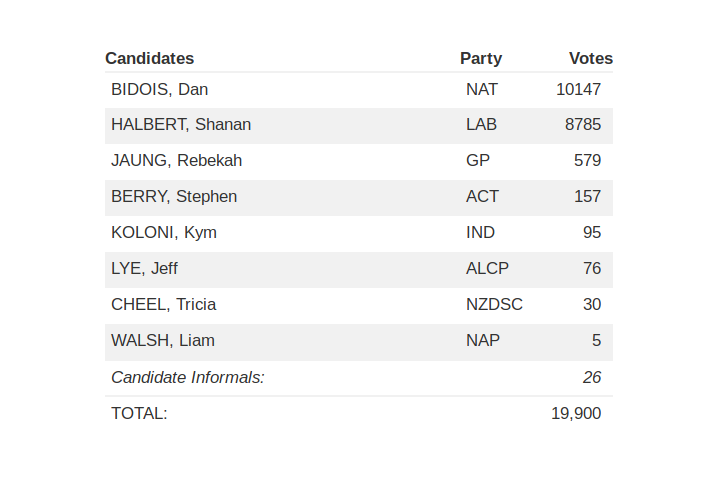
As the night progressed, we watched the election results roll in with a great amount of disinterest, and eventually we called a toast for a great result. Less than 50% of the electorate had turned out to vote and, let’s be honest, why would they bother?

My individual score was five votes too many. Those five people must have some sort of personal issue with me and wanted to send a strong message of hatred by slinging votes my way. Either that, or they got the joke and hoped that electing me would lead to more laughs. Thankfully we’ll never know. I’m far too busy for that kind of carry on.

It was hilarious to see the One Nation of Racism candidate Kym Koloni fail to crack the hundy despite putting all that effort in, and satisfying to see both ACT and the Greens lose their election deposits by not reaching 5%. That’s what you get for becoming an appendage to the larger parties! The pendulum swings from blue to red and back again, while the little guys get eaten and achieve nothing.

This is yet another travesty of the in-joke that is representative democracy. An undeniable majority of people in Northcote chose not to vote. Not to send Dan Bidois off to sit in a seat at the back of Parliament and collect six figures of extorted taxpayers’ money. Those non-votes will be ignored.

The non-voting public can rest easy though. While the gravy train passengers squabble to falsely represent you, despite the strong message you sent by not voting for any of them, we at Not A Party will continue to not represent you and let you do your own thing. Personally I’ll be off to work, the grass keeps on growing back.

Liam Walsh
[email protected]

ENDS

Categories
Not A Party, not a problem

The Northcote By-Election Result is Fraudulent and Illegitimate

Northcote by-election candidate Dan Bidois was crowned the winner, despite only getting the support of 21% of eligible voters

The reason why our ruling class have the right to rule, so they claim, is because they have the consent of the masses. But the winner of yesterday’s Northcote by-election and newly crowned Member of Parliament, Dan Bidois, did not have the consent of the masses. Therefore, the Northcote by-election result is fraudulent and illegitimate.

19,900 people cast a vote in the Northcote by-election. According to the Northcote Electoral Profile on the Parliamentary Profiles page, there are 49,569 eligible voters in that electorate. This tells us that barely more than 40% of eligible voters chose to participate in the democratic process – something like 30,000 people abstained.

The question then has to be asked: how is the election of Bidois to the House of Representatives legitimate, when fewer than half of eligible voters took part in the election process? If so few people believed that the democratic process was worth participating in, isn’t that sufficient evidence that it has failed, that its claims of legitimacy are fraudulent?

Bidois himself won 10,147 votes in the by-election, which amounts to almost 21% of the eligible voters in Northcote. If no-one cares about the election, how can the winner of it legitimately claim to have any power to rule anyone? Any reasonable person can see that this is absurd. We can’t possibly know what the electorate wants unless we canvas the non-voters.

One candidate, Liam Walsh of Not A Party, ran specifically on the non-vote. His platform was that democracy has failed and is inherently corrupt (hard to deny) and that it would be better for us to scrap it entirely and work together instead of using the democratic system to try and fuck each other over.

After all, as a National MP, Dan Bidois will immediately work towards the further enslavement of the young, the Maori and the working class. Walsh notes that Bidois came second to an empty seat.

One wonders what would happen if those 60% of adults in Northcote who do not feel represented by New Zealand’s peculiar imitation of democracy gave their allegiance to Walsh instead of to the central government.

What if, instead of paying taxes to the IRD to piss up the wall on flag referendums, yacht races, imprisoning medicinal cannabis growers and importing Somali rapists, people paid no taxes, and we had neither flag referendums nor a justice system putting people in cages for growing medicinal plants?

Some might respond that having no democratic government will leave the community unable to solve problems that require collective solutions, but Dan Bidois, with his 21% support, sure as fuck isn’t going to be solving them either. He, like the majority of backbenchers, will stick his nose straight up the arsehole of his party’s leader, in this case Simon Bridges, and he will keep it wedged there as long as the National Party hierarchy is responsible for his meal ticket. As a consequence he will vote to enforce National Party policy and dogma – not the will of the Northcote electorate.

A democratic election that gets 40% turnout cannot claim to return a legitimate ruler. The vast majority of the Northcote electorate did not consent to being represented by Bidois; therefore, his being in the House of Representatives is no more legitimate than it would have been if the CIA had helped him raise an army that seized power through force.

After all, a foreign-backed dictatorship might even gain the consent of more than 21% of the population – assuming it put a sufficiently enlightened person on the throne – which would make it no less legitimate than yesterday’s by-election.

If the democratic process is rejected by a majority of the people, then it’s time to get together and to think up a new political philosophy that adequately represents them. It’s apparent from the fact that New Zealand clings to cannabis prohibition, a policy supported by almost no-one, that the will of the people is not represented by the law enacted by their rulers. This failure to represent the people’s will is evidence that democracy has failed and needs to be superceded.

The Northcote By-Election Result is Fraudulent and Illegitimate

Categories
Not A Party, not a problem

Why the 2018 Labour Budget Was so Underwhelming

The 2018 Budget, like the 2000 one, was extremely tight; the 2020 Budget will be a lolly scramble, as the 2002 one was.

“Yet, for all the hype, [the Finance Minister and the Prime Minister] were at pains to reassure big business and employer groups that this was above all a ‘fiscally responsible’ budget. Its commitments to social spending would not jeopardise Labour’s intention to maintain a surplus, they emphasised…” The two Labour Party politicians mentioned here are Grant Robertson and Jacinda Ardern, speaking in 2018 right? Wrong—they are Michael Cullen and Helen Clark, speaking 18 years ago in the year 2000.

The quote in the opening paragraph comes from this article from 2000, discussing the first Budget of the new Fifth Labour Government. Other quotes of interest from the same source are: “the increases fall far short of what is required to address the acute levels of social and economic inequality now embedded deep within the social structure”, “The majority of families forced to rent from private landlords will be no better off than before” and “Labour and the Alliance have done nothing to restore the vicious cuts to unemployment benefits and welfare that were implemented by the National Party”.

So if you’ve been listening to the Sixth Labour Government explain why this year’s Budget helps almost no-one and you’re starting to realise that you’ve heard this exact same bullshit story before, sit tight while we explain why—and what’s going to happen next.

After nine of years of neglect, including closing down rape crisis centres and overseeing the world’s highest youth suicide rate, the Fifth National Government was finally—although narrowly—voted out of power. The Sixth Labour Government came to power with a strong commitment and mandate to do something about the rape and pillage of the New Zealand populace by the plutocrats.

So the 2018 Budget surprised many commentators with how weak it was. The consensus described it as “National-lite”, and, indeed, it did almost nothing to help anyone. Many asked themselves why it was that an incoming Labour Government would deliver such a weak Budget. Didn’t they want to create the impression that they were doing something to help? Why miss this golden opportunity to set things right?

The answer to this conundrum comes from examining the 2002 Budget, which was released a few months before the General Election that year. That year’s Budget sent the New Zealand business community into paroxysms of rage.

The Employers & Manufacturers Association complained that “The huge $3.31 billion increase in new spending in the Budget for the next financial year is more than double the increase in new spending for the past two years combined”, and then National Party leader Bill English was enraged by “Labour and their higher operating balances, as well as higher taxes, increasing debt and billions of taxpayers’ dollars invested overseas”. There was even money for pure luxury items like refugee resettlement.

These increases impressed the population, as they were the first real relief Kiwis had been given in 18 years of relentless neoliberalism, and they duly returned the Labour Party to power. Kiwis contrasted this big spend-up with the cruelty of the National Party Budgets under Ruth Richardson, and the Nats were duly slaughtered, falling to 21% of the votes, their lowest result in 100 years.

It was a lesson for all, not least the Labour Party.

So the reason why the Sixth Labour Government did next to nothing to fix the nine years of neglect that the Fifth National Government put us through is simple: they’re saving the lolly scramble until just before the 2020 General Election. You can almost guarantee that, when the 2020 Budget rolls around, the grip of the New Zealand ruling class around the throat of the population will be loosened just enough to enable us to express our gratitude by returning Jacinda Ardern’s Government to power for a second term.

This is not a nefarious new trick, dreamed up by a crack team of political consultants—it’s straight out of the Helen Clark playbook. We can confidently predict another weak Budget in 2019 before the conspicuous generosity of the 2020 one, and we can also almost guarantee that if Labour wins a second term this would see us having two more weak Budgets in 2021 and 2022 before another lolly scramble in time for the 2023 General Election. Then, if they win a third, there will be weak Budgets in 2024 and 2025 before yet another lolly scramble in 2026.

This pattern is no less predictable than the General Electoral Cycle itself is, and could even be said to be part of it. Plus ça change, plus c’est la même chose.

Why the 2018 Labour Budget Was so Underwhelming

Categories
Not A Party, not a problem

Not A Party candidate Liam Walsh: Doing The Least For Northcote

MEDIA RELEASE
Not A Party

15 May 2018

Not A Party candidate Liam Walsh: Doing The Least For Northcote

Yeah gidday Northcote, I’m Liam Walsh and I’ve got an important message for you about an upcoming opportunity to do things better. In fact it’s really just an opportunity to do things, they don’t even have to be better as long as you do them for yourself.

Earlier this year, Jonathan Coleman decided his cot was far too full of toys and it was time to throw them out. The opposition benches weren’t as comfortable as he’d expected they might be and he just wasn’t having it anymore. While I understand that some of you might be upset that he stood for election and didn’t even finish his term, this is actually a great kindness for the people of Northcote.

Some of you will be over the moon for an opportunity to no longer have a member of the National party representing you, some of you will be eagerly anticipating the chance to make sure a member of the Labour party doesn’t represent you for the remainder of this term. Some of you might be looking forward to voting against any of the candidates who have put their names forward, I’m sure the vast majority of you will feel that way about me and that’s GOOD.

In fact it’s so good that you want to vote against the majority of these candidates that I’m really only here to help you take the next logical step: go one better, vote against all of us by not voting, your non-vote counts! If this seems crazy to you let me explain further.

Northcote, you’ve had Coleman since 2005, that’s a long time in anyone’s book, and honestly what’s he done? He’s been busy playing kings and emperors, involved in positioning and power struggles, followed John Key around like a puppy dog, said some mean things about some other time wasters and probably any number of other pointless and ineffective activities.

Let’s be honest: a vast majority of, if not all of, the things that have happened to you, for you and around you since 2005 have had nothing at all to do with Coleman. You’ve made your own decisions and done your best or your worst—or something in between—based on your own judgement, and you’ve paid Coleman and 120-odd other politicians a fat sack of cash for the right to do so.

What I’m promising you, Northcote, is that nothing needs to change. If elected, I commit to being an even less effective MP than Jonathan: I’ll do even less than he did, participate even less in democracy and have even less of an impact on your lives because, unlike any of the other candidates, I’ve got faith in you. You’ve got this. You can get together in your communities and make your own calls.

I’ll also cost you nothing at all because, to be honest, I’ve got a lot of lawns to mow down Wellington and I just don’t have time to muck around in Parliament. The only time you’ll ever hear “Liam Walsh”, “swearing” and “the Queen” in the same sentence will absolutely not be a revelation that I’ve publicly lied by taking the Parliamentary Oath so don’t worry about that.

If you’re still confused by now, you’re probably thinking “there’s no way I’m voting for this guy” and, if you stop and think about it for a few minutes, that actually means you’ve understood perfectly and you’ve done it all by yourself! No having to pay me taxes, no being arrested by my employees for not doing what I’ve said and no need to ask me permission to do things that I wouldn’t have known or cared you were doing anyway.

TL;DR: Please don’t vote for me but also PLEASE don’t vote, for me.

Liam Walsh
[email protected]

ENDS

Categories
Not A Party, not a problem

The Greater Electoral Cycle

If you’re in your mid-30s, and start feeling like you’ve seen it all before, it’s because you have.

Many commentators like to talk about what they call the electoral cycle. This refers to the fact that, in the vast majority of modern liberal democracies, a party coming to power inevitably soon hits a high point and then steadily loses support over time until they are ousted. This essay looks at a broader phenomenon that we will call the Greater Electoral Cycle.

The Lesser Electoral Cycle is the one that most people, by now, are well familiar with. A party or President comes to power, immediately makes the changes that the previous regime had neglected to make, then rides a wave of popular support, until inevitably their own lust to cling onto power at all costs causes them to make poor moral decisions and the voters throw them out in disgust.

In the old days, this expulsion of the previous rulers could lead to any kind of new philosophy or ideology taking its place. If the previous rulers weren’t good enough, try fascism, try democracy, try republicanism, try anarchy. So there was no real greater cycle beyond this. It was just come to power and cling to power for as long as possible.

In recent decades, now that the ruling classes have refined and perfected their strategies for dividing and brainwashing us, all we get is neoliberalism with a red mask or neoliberalism with a blue one. The Greater Electoral Cycle, then, is from the start of one government to the start of another government of that kind (i.e centre-right or centre-left).

New greater cycles begin all the time. One has just now begun after 16 years in America, and one has begun after 18 years in New Zealand. Because of this, anyone with a memory that goes back 20 years or so has by now heard all the arguments and excuses already, and is starting to hear them again. Political arguments, like fashions and the Teenage Mutant Ninja Turtles, are simply repackaged every generation for a new audience not exposed to them yet.

For example, Internet commentators often make reference to Trump Derangement Syndrome. This is a joke referring to the reactions of people on the left to the election of Donald Trump as American President. The idea is that many leftists have reacted so badly to the news of Trump’s ascendancy that they have essentially become clinically deranged.

Those who have been around a bit longer remember this as Obama Derangement Syndrome, which is essentially the same thing but triggered by the sight of Barack Obama as President. Those of us as old as Generation X might even remember everyone talking about Bush Derangement Syndrome, and there might have been a Clinton Derangement Syndrome before that.

A lot of Millennials have now observed that Trump is little different from George W Bush in a lot of ways, and the Democrats’ reactions to him are very similar to their reactions to Dubya. Trump, like Dubya, uses certain patterns of speech to appeal to people who aren’t particularly well educated. His concern is that he might cause resentment and alienation by speaking to them in long sentences with multiple clauses and ten-dollar words. So he’s painted as dumb – when he really isn’t dumb.

Likewise, in New Zealand, Jacinda Ardern tells many of the same lies as her Labour predecessor Helen Clark, from whose playbook Ardern appears to be reading. Claiming that the previous Government left the books in a terrible state, and so there’s much less money available than anyone supposedly thought, Ardern’s Labour has gone back on almost all of its spending promises. Typically, they will suggest in 2020 that we will have to vote them in again if we actually want all those goodies, because we sure won’t get them from National.

If we want to know what’s happening next in the Greater Electoral Cycle, we just need to look at what happened at this point last time. The Democrats in America will probably run a weak candidate because incumbent Presidents are rarely prevented from winning a second term (not even George W Bush failed to do so). Trump will probably easily defeat them, as he will be in the high point of the centre-right part of the cycle.

The National Party of New Zealand has already handed the poisoned chalice to Simon Bridges, who is unimpressive even by the low standards of New Zealand politicians. He will probably lead National to a crushing defeat akin to that suffered by Bill English in 2002.

The West will keep going around and around in these greater cycles until the charade of democracy finally ends. At that point, either a tyrant arises to take us all to hell or a new movement of philosopher-kings arises and initiates a new Golden Age.

The Greater Electoral Cycle

Categories
Cannabis Capitalism Democracy Not A Party, not a problem The State

Should the others vote?

The state is a safe space, that’s its job. From inception, bringing six constables to the shores in 1840 those organising a state on the islands of New Zealand have used variations of creating “law and order”, economic stability, integrated cultural conformity, gender normalisation and security to justify intervention in the lives people living in Aotearoa. If not overtly mentioned by those calling for, maintaining, and defending the state these goals are largely expected by those who vote to be delivered in some way in exchange for their taxes.

Today’s New Zealand has not achieved this at all. Unknown and untested chemicals flood across the borders causing unknown short-term and long-term damage to those who use them and those who love those users. The state continues to target cannabis plants with generations of anecdotal knowledge and decades of scientific research behind its use giving clear and known risks. In the interests of public safety and economic stability it’s easier to get methamphetamine than cannabis in New Zealand, with the most damaging drugs of all available for purchase in most supermarkets and yet change is angrily resisted.

This is far from safe and can be seen as related if you understand protecting our profit earning overseas by signing trade deals and allowing streamlined entry of goods into the country. So you can buy cheap products online, while police are “protecting the public” with violent raids on anything grown on our own soil, this means synthetic drugs and their precursors will always be cheaper and easier to get and produce than an actual weed that will grow wild.

Not A Party has argued for a “don’t vote” strategy in previous elections and I want to encourage the party to change tack entirely for the reformist coalition leg of bipartisan dictatorship. We have in office the party that oversaw the 15 October 2007 “Operation Eight” raids. Aside from the horrifying fallout of neo-colonial troops armed with assault weapons yet again on the confiscation line in Te Urewera, searching school buses and elderly at gunpoint in the interests of “national security”. The police apologised for that.

The police also on that day raided multiple addresses of political activists, taking computers and documents and proving absolutely no one was actually guilty of any terrorism at all under the law adopted on US government request by New Zealand, the Terrorism Suppression Act 2002. The outcome of court cases aside, pay attention to what the police believe the most dangerous threat to security is. Activists who target and protest the actions of corporations and anyone who feels their people should have dignity, self-determination and freedom on these islands from the post-colonial settler state government.

In Terror In Our Midst Brendan Hokowhitu explains what has happened since adopting this law, based on a perpetual war against “terror” in Western society.

Essentially, the discourse promoted by the Bush administration, in cahoots with other western governments such as Britain, was fostered on the grounds “others” had fewer rights than the normal population. Interestingly, the transforming morality is regressing in part due to the pre-enlightened discourses espoused by the Bush administration especially. Discourses based on ‘the will of god’ and ‘good and evil’ have quickly positioned the Other as ‘evil’ and the self as ‘good’. The moral retrogression has served those in power the mandate to enact absolute sovereign-like justice.

The “terrorists” are defined by the state in the first place then labeled instantly the other, the “bad” because the state is always “good”. So we have a drone war summarily executing the others in the middle east with robots to provide us all with the illusion of security and a “defence force” that attacks the mental health of journalists like a state sanctioned internet troll before being forced to admit the SAS did raid the village in Afghanistan killing civilians as outlined by Jon Stephenson and Nicky Hager in Hit and Run. The police have raided journalists repeatedly since the inception of our war on terror with following legislation passed at the urging of the Obama administration by John Key reducing the rights of journalists when doing the job they should be of holding a microscope to society. No terrorists have yet been found amongst us, the others, and as we know the state does not see what it does as terror.

Far from delivering us from the real threat of the day, the introduction of this legislation and resulting raids did not create a safe space to stop the 2007 GFC causing a retraction of the economy, a rise in suicide rates, and paving the way socially for a massive increase in the “legal” flood of synthetic drugs into dairies and stores destroying many working families. Also directly affected were those who the then incoming PM described as an “underclass”, an “other” that once he got into office were to be given less rights than the “good” Kiwis. Drug testing and invasions of beneficiaries’ privacy up to the then Minister of Social Development releasing personal details of her critics to media while suing anyone threatening to release hers.

Why does any of this mean you should vote in the next election or any referendum? Just because John Key is out and GenXers run most wings of our pluralist dictatorship the ‘underclass’ he othered into economic doldrums have not gone anywhere. The level of control over others the police are willing to exert has not diminished. The hold-out NZ First still lead by the old guard, has for 24 years been seen as “picking the winner” in many a media talking head pluralist analysis prior to elections and has actually played this role three times. Forget your electoral colleges, we have Rob Muldoon’s apprentice picking our governments. Two pieces of legislation jump out to me as furthering the othering of some minority groups, neither is the upcoming New Zealand cannabis referendum. One is the waka-jumping bill that gives enormous power to the “good” party leaders over their “bad” disgruntled MPs who want to leave their party, possibly to do something from inside the Parliament on behalf of their perceived voter base to represent them.

The second and more important in my mind is to make all referendums binding. This most certainly has the ability to be misused to push a majority agenda brutally down the throat of those who disagree with it or are born different from its enforced norms through state sanctioned terror and violence. I hear the concerns of some groups and inside Not A Party and counter we already have that now. It happens now from birth to the grave. The state is using coercion, fear, and violence on us “others” to protect its “good” self. Direct democracy may lead to direct oppression of minorities, some of those minorities being party leaders.

Representation relies on the person you voted in interpreting how you would vote on issues introduced for discussion in Parliament. The party leaders can now interpret how they will as long as their caucus supports them and fringe opinions can be othered out of Parliament entirely to be replaced by a new representative. Having to get the majority to back your rights in a referendum will be no easy feat, the alternative is to see party leaders take the last tool your representative has to rebel (whether you voted for one or not) which is quitting the party and fighting out the term on behalf of either their own naked self-interest or from their perceived opinions of those like yourself who put them in Parliament.

If you made it this far you are already an other to the state somewhere, I’m guessing. Environmentalists have been othered by the state forces since their inception despite having a party inside the government proving they are in fact no longer others but members of the state attempting to create a safe sustainable space for their children in the future. Most of us never become so othered by the state that they will raid our communities like we are housing enemy combatants in the perpetual terror war. Or be othered so much we are detained and forced into medical treatment we don’t want. And it’s mostly to preserve the “good” state. By holding a population at gunpoint as if the entire community is a threat to the “good” state or targeting activists to be removed carefully (although not quietly) from their “good” communities the police have shown how they intend to enforce the terror laws here. The subsequent raids to collect evidence from journalists Heather Du Plessis-Allan and Barry Soper after Du Plessis-Allan showed you can now buy firearms online without a licence as if the problem is yet another case demonstrating glaring flaws with their safe space neoliberal state model. It is as if the real threat to state internal safety of the population does not lie with large corporations producing chemicals for “research” that turn out just to be poisons or addictive synthetics. Or banks producing CDOs that turned out to bankrupt working people with bad mortgages, no job and an eviction notice. Or that success stories like Trade Me are wide open to unsafe use by violence minded people. The corporations and banks are always cast as “good” in this environment and their victimised and lied-to consumers the “other”. Those of us who point this out are now the truly bad and may well become “terrorists” in the eyes of police whose primary job as they see is to protect the “good” from us “the others”. Many of you will at some point be othered by the police for political views alone, and if you get challenging enough your othering will lead to terrorisation BY the police of your community while removing you from it.

Pushing for cannabis law reform shouldn’t need to be argued here, but I will, in that it removes a tool the police can use to harass and oppress us others with very real threats of violence for failure to comply. Forcing CIR to be binding will be another othering tool in some hands, but it could be the leaders of those parties we can other with it. If not, this will get worse, it probably will anyway despite the Labour Party’s noises about child poverty, a 24% increase in house prices corresponding with less than half that in wage growth during the first six months of Jacindamania. We can expect that, like Helen Clark’s promises of universal student allowances or John Key’s promise of wages climbing to Australia’s level, we will see the young, the non-white immigrants, Maori, LGBTIQ, and anyone whose politics isn’t “good” enough for state security forces to be othered economically and blamed for our outcomes by enthusiastic supporters of the state. This administration complete with Winston Peters telling us capitalism has failed many of us spent its first six months signing among other things the CPTTP thus strengthening the very concept of corporate rights as good and local independence as the other which has failed so many Kiwis already.

If only we could run a binding referendum that Prime Ministers do the unthinkable and are forced to enact serious economic reforms they have promised to on the campaign trail?